OUR HISTORY

Our history isn’t written, it’s brewed.

The growing popularity of DAB beer was no accident but the logical consequence of its high quality, the result of the best possible ingredients and advanced production processes.
1868

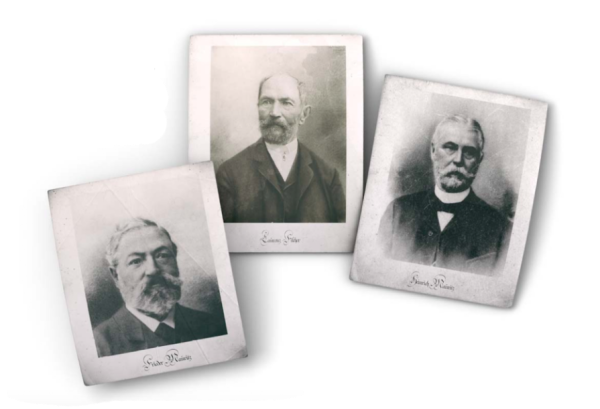
1868 is a milestone in German brewing history: The coal and steel boom is in full swing in Dortmund. A new era has started. Businessmen Laurenz Fischer and Heinrich and Friedrich Mauritz establish a highly advanced steam brewery, Bier-Brauerei Herberz & Cie., together with master brewer Heinrich Herberz.

Three black and white photographs of older men from the late 19th century are scattered on a surface.

1872

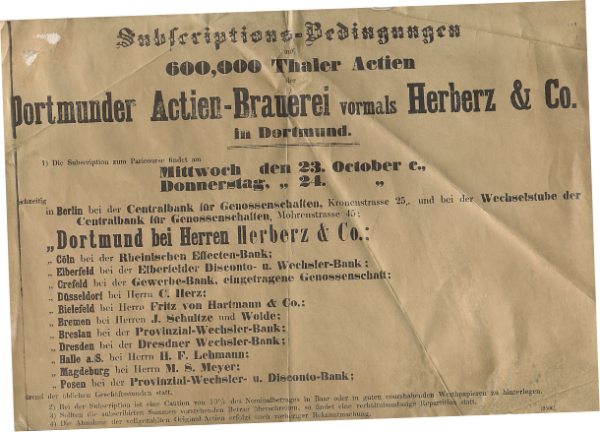
Business is good. The brewery is steadily expanded and a malthouse is added. The brewery becomes a joint stock company under the name of “Dortmunder Actien-Brauerei formerly Herberz & Co.”

An old advertisement for shares in the Dortmund Actien-Brauerei, damaged at the edges and discolored over time.

1879

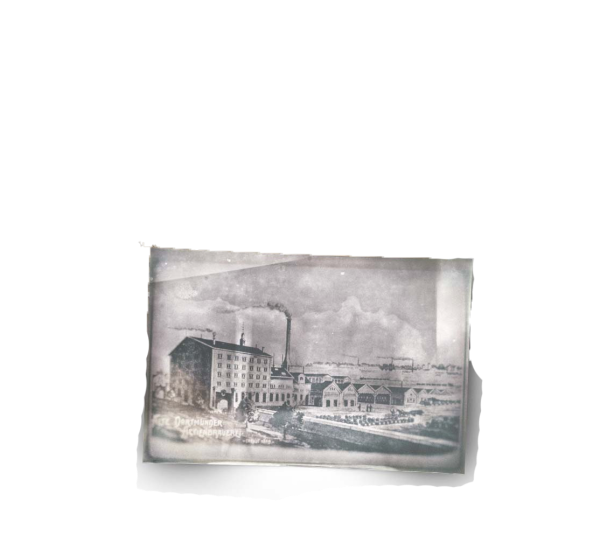
DAB enters the export market, filling its first casks for overseas destinations. Customers in Africa, India, Japan and Australia come to appreciate the outstanding quality of DAB beer.

A historical black and white photo depicts an industrial scene with buildings and smokestacks.

1881

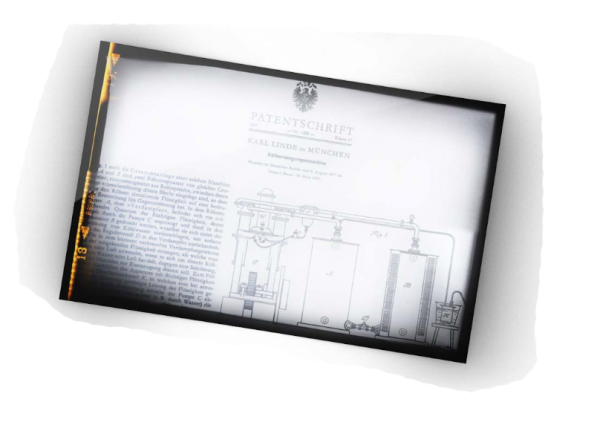
Prof. Carl Linde in person supervises the installation of a refrigeration machine of the type he had pioneered. In the cellar, permanent cooling is now available. This lays the foundation for the predominance of bottom fermentation.

A framed patent document with detailed schematics and German text attributed to Karl Linde.

1885

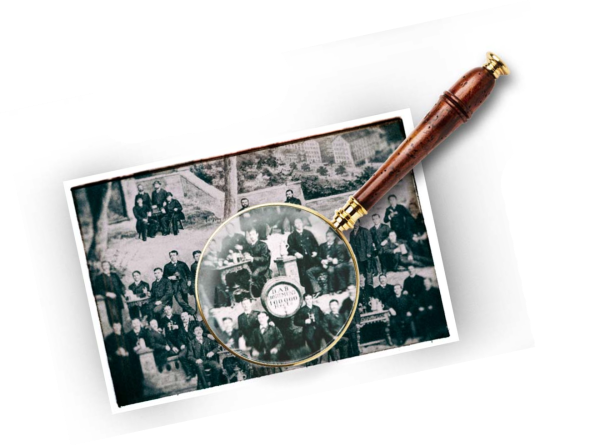
Annual production exceeds 100,000 hectolitres, a tremendous achievement for the time.

A magnifying glass enhances part of an old photograph showing a group of people outdoors.

1900

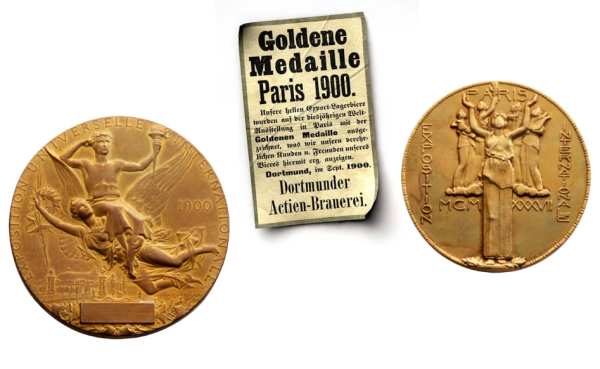
DAB’s “Dortmunder” beer wins the highest international honours. DAB is awarded a Gold Medal at the Paris World’s Fair

Three items are displayed: two gold medals and a newspaper clipping. The clipping describes an award from Paris in 1900.

1913

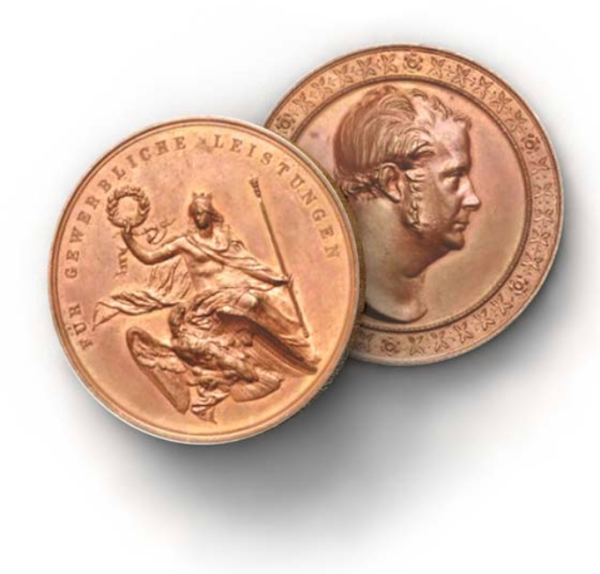
For special achievements in brewing, DAB is awarded the Prussian State Medal, the highest honour available, at Düsseldorf Trade Fair.

Two copper coins are depicted, one showing a profile of a man and the other an embossed figure of a woman with an eagle.

1914-17

The First World War interrupts decades of steady growth. Many employees are conscripted. Beer quality suffers as a result of the low brewing barley quotas. Civilians can only obtain beer if they work in industries essential to the war effort. Beer production, which had reached 250,000 hectolitres in 1913, slumps.

1917

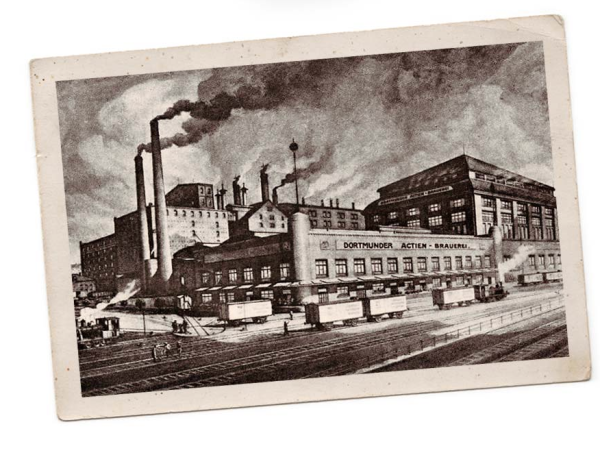
DAB receives its own railway sidings, allowing goods trains to be loaded directly from the factory ramp.

A vintage postcard depicts a large industrial brewery with smokestacks emitting smoke, set against a cloudy sky.

1930

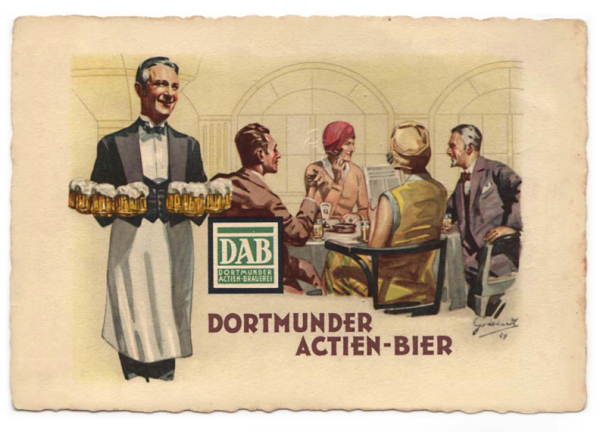
After years of recession, currency reform ends one of the blackest chapters in German economic history in the mid-1920s. Once again, good beer is available for good money. By 1930, production at DAB reaches about 770,000 hectolitres.

A waiter holds a tray with six beer glasses, serving four people seated at a restaurant table.

1937

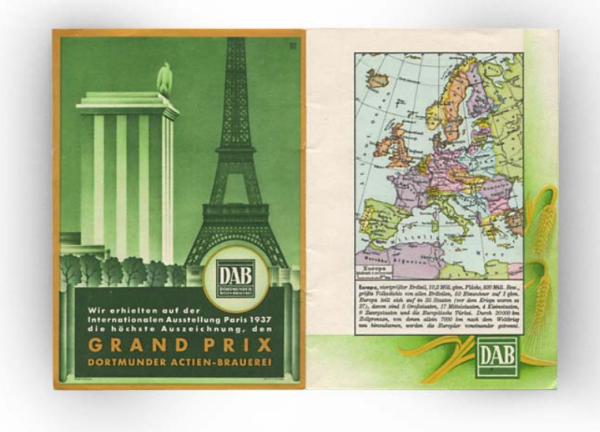
Dortmunder Actien-Brauerei is awarded the “Grand Prix” for the high quality of its beers at the Paris World’s Fair.

An open vintage booklet features a poster with the Eiffel Tower and a European map on opposite pages.

1939

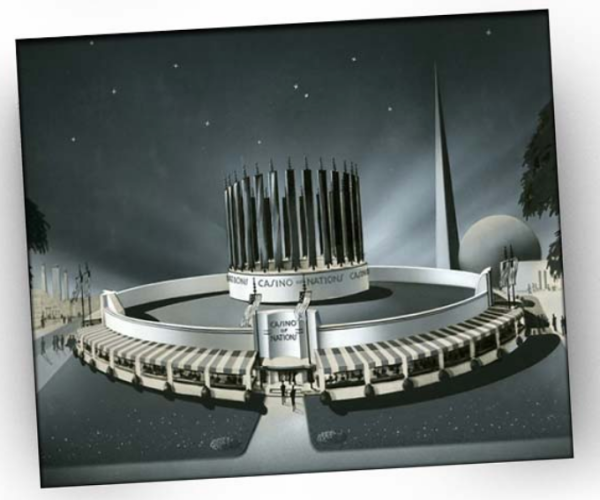
DAB presents its products at the World’s Fair in New York.

A stylized round building with vertical pillars at night under a starry sky, accompanied by a sleek, tall spire.

1939-45

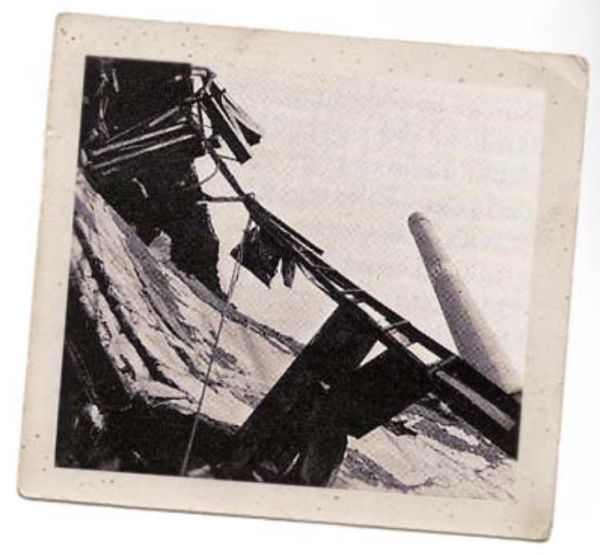
In the Second World War, Dortmund, the centre of the German coal industry, is almost completely destroyed.

A damaged wooden structure on a steep, snowy slope with debris and broken parts.

1949

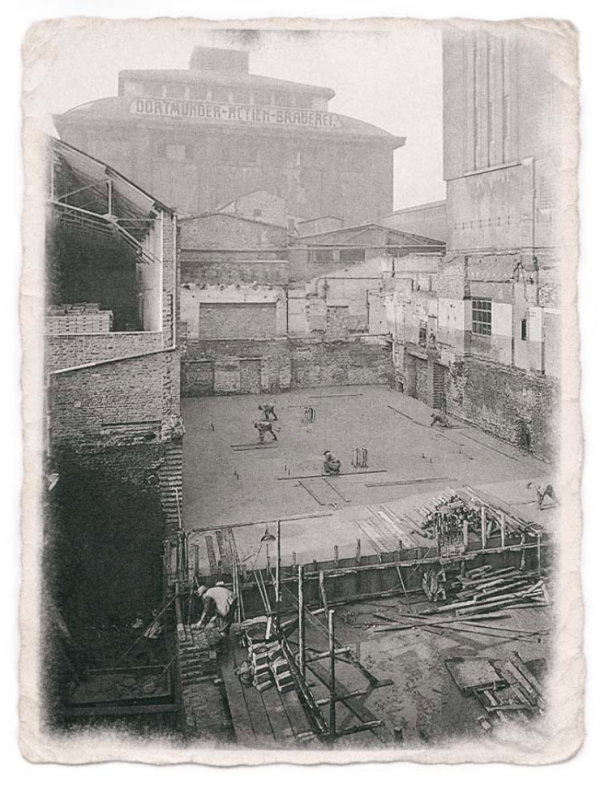
Thanks to tireless activity, a new DAB brewery reaches completion by 1949.

A historical black and white photo of a construction site with workers and large buildings in the background.

1958

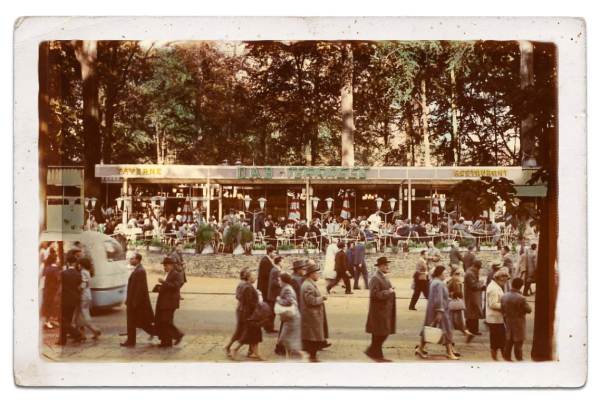
DAB presents its products at the World’s Fair in Brussels. The DAB Terrassen is one of the favourite meeting points.

A busy outdoor cafe with many patrons sits adjacent to a bustling street where people are walking.

1959

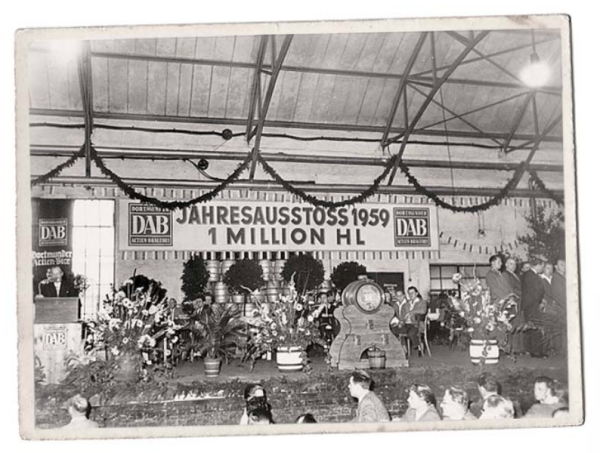
Ten years after completion of the new brewery, DAB becomes the second German brewer to celebrate annual production of a million hectolitres.

A historic event in 1959, when large crowds gathered to celebrate an annual production of 1 million hectoliters.

1963

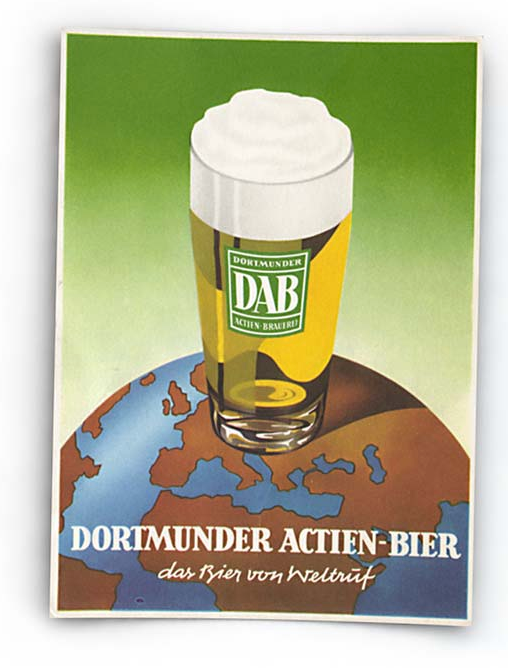
In 1959, DAB starts to replace wooden casks by aluminium casks which are lighter and easier to handle. By 1963, the changeover is complete. DAB once again demonstrates its leading role in the brewing industry.

A glass of beer rests on a stylized globe in an advertisement poster.

1966

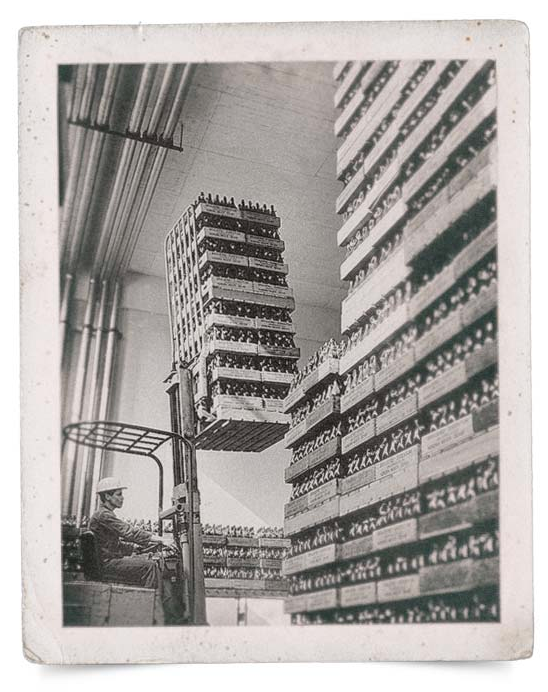
In 1966/67, DAB invests DM 9 million in lightweight plastic crates and European standard bottles, which become the standard for returnable bottles in Germany. DAB is also one of the first breweries to replace the swing-top seals and steinie bottles previously used.

A worker in a cap operates a forklift, stacking crates in a large warehouse.

1968

DAB celebrates its 100th anniversary and produces 1.6 million hectolitres of beer.

1971

DAB acquires a controlling stake in Hansa-Brauerei, also based in Dortmund.

A red, blue, and white emblem features a large sailing ship above the word

1983

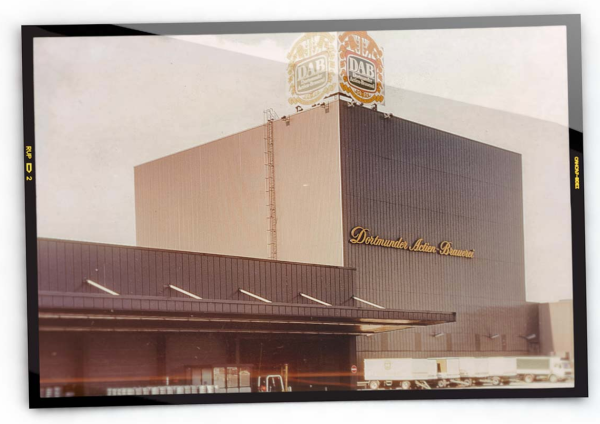
After three years of building, a new brewery is commissioned on the 100,000 sq. m site of the former Hansa brewery, the scene of many milestones in Dortmund’s brewing history. The new plant is one of the most advanced in Europe. In 1984, the new DAB plant is the largest brewery in the Ruhr area, producing 2.8 million hectolitres of beer per year.

A large industrial building with a logo at the top and trucks parked at a loading dock.

1990

A new bottling unit designed to fill 80,000 returnable bottles per hour is completed.

1991

Binding-Brauerei AG acquires the DAB shares of Dr. August Oetker KG with effect from 30 September 1991.

1996

Establishment of the Dortmund brewing alliance in October 1996. DAB takes over the brands and distribution rights of the Kronen brewery, Dortmund.

A logo features a crown atop an oval with the text

1997

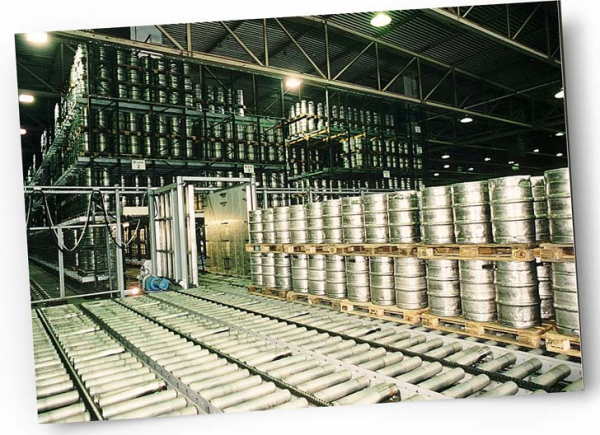
DAB boosts its brewing capacity from 3.4 million to 4 million hectolitres. The expansion is necessary as a result of market growth and the acquisitions of the previous years.

A conveyor system transports metal beer kegs in a large industrial brewery.

1999

DAB commissions a new high-capacity cask filling plant.

2003

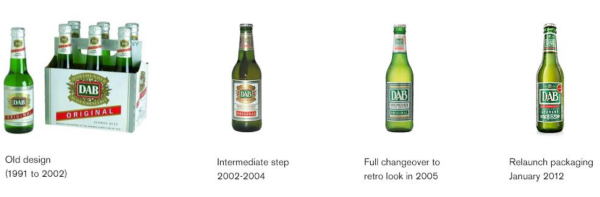
The domestic brands and products of Dortmunder Actien-Brauerei receive a new design reminiscent of historic models. They are adapted to the international brands in 2004

2020

A series of four beer bottles and packaging showing their design evolution from 1991 to 2012.

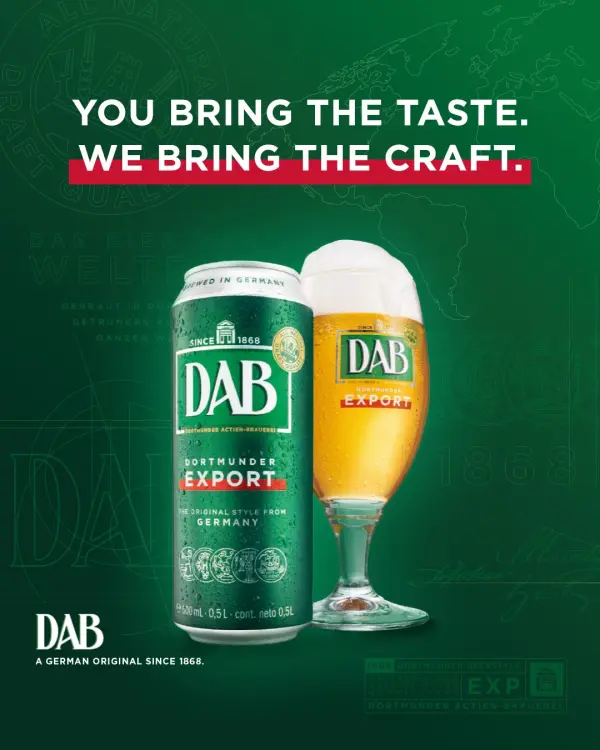
Design relaunch of the DAB packaging range.

A beer can and a filled glass of DAB Export stand side by side on a green background with subtle graphics.

2025

Design Relaunch

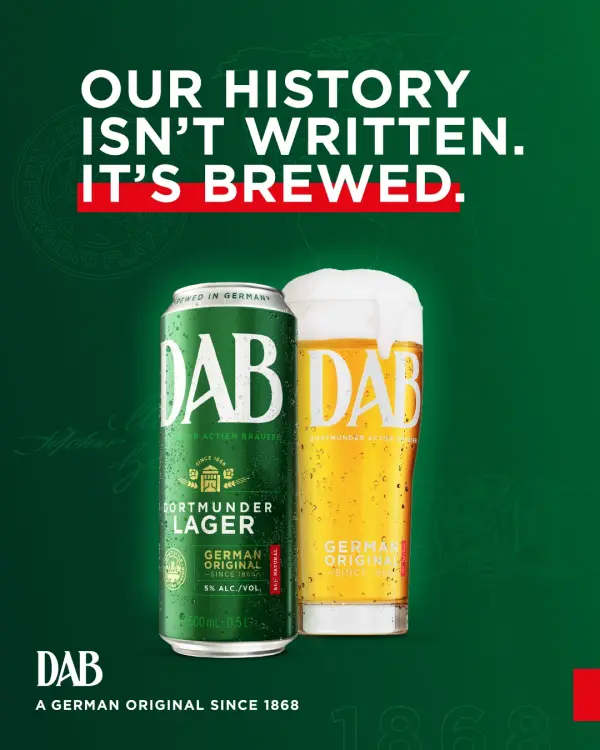
A fresh, bold look of our beer brand with our exciting design relaunch, reflecting our commitment to quality and innovation. With a modern aesthetic that honors our heritage, we're ready to bring a new experience to every sip.

A beer can and a filled glass of DAB Lager stand side by side on a green background with subtle graphics.

2025

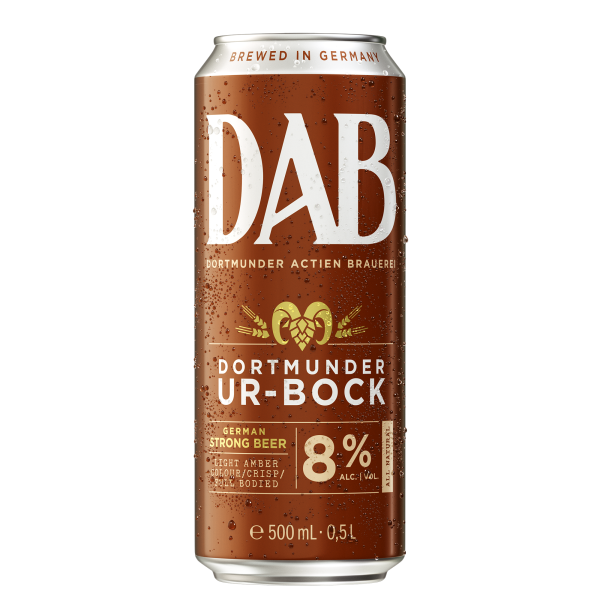
Introduction of Dortmunder Ur-Bock

Discover our bold new strong beer – a premium strong lager that blends tradition with unmatched strength and taste.

DAB Ur-Bock beer can